What If Singapore’s Merlion Ran on Steam?
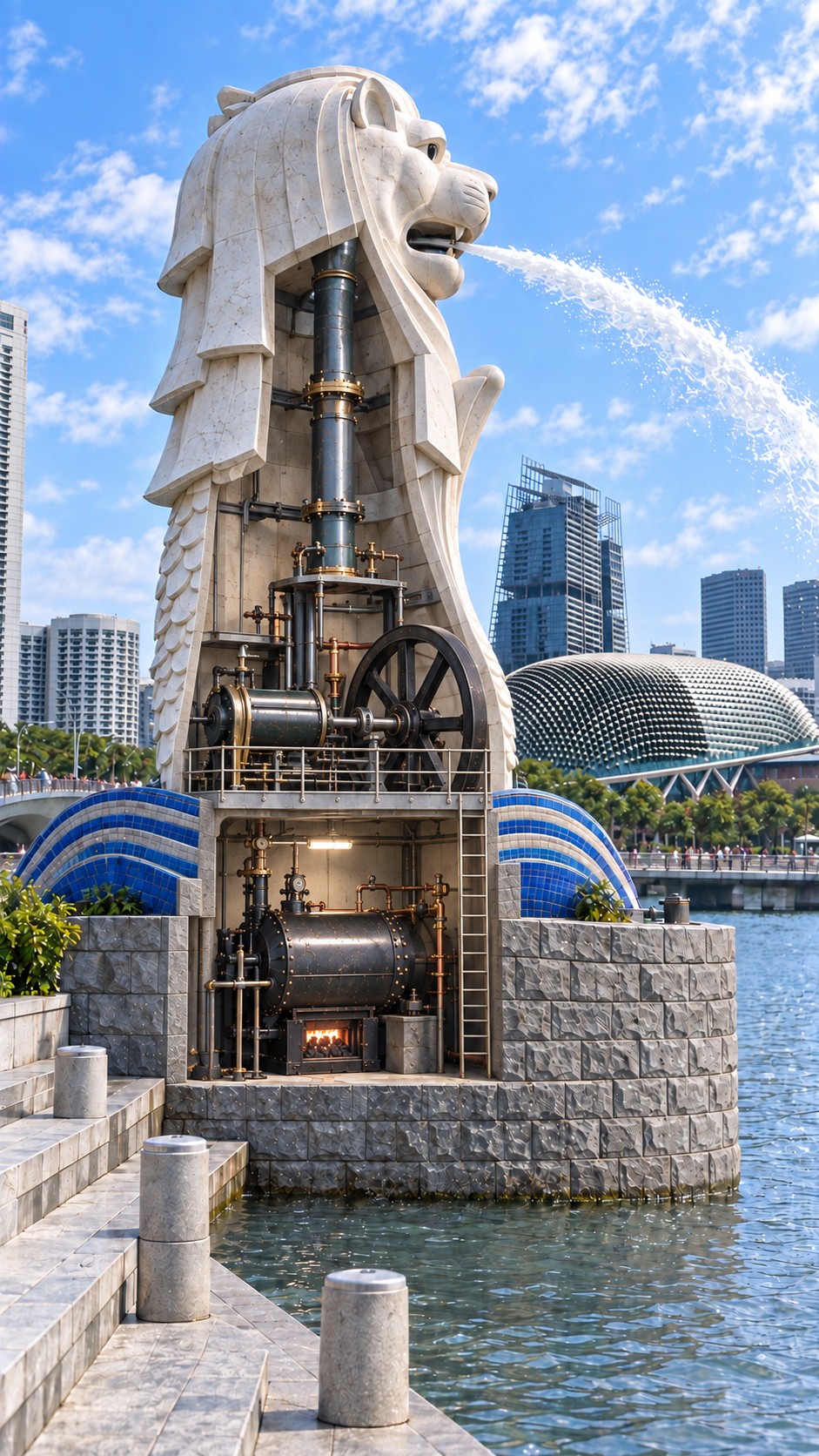
I wanted to put a steam engine inside the Merlion. An old British one, salvaged from a tugboat, still driving Singapore’s familiar waterfront fountain. Somewhere inside, the last Englishman who understood the machinery would be keeping it alive.
This was an entirely invented piece of Singapore heritage. The plan was to tell it with the calm confidence of a science documentary: cut through the statue, follow the steam, watch the piston move, and emerge with a perfectly unreasonable explanation for all that water.
Here is the finished film. It takes 55 seconds. Making the piston stay attached took rather longer.
A small addition to British heritage
I had heard about the popularity of those cutaway videos that reveal how something works. A solid object opens up, its insides start moving, and suddenly you want to follow every pipe. The Merlion, Singapore’s half-lion, half-fish waterfront mascot, seemed an excellent candidate.
I gave it an elderly steam engine from a retired tugboat, and a bearded English mechanic called Arthur, in shorts rather than a theatrical Victorian costume. Soon the whole arrangement would be replaced with a soulless electric pump. Progress, obviously.
But there was a loose end: where would the steam go?
ChatGPT suggested Gardens by the Bay, where it could become the mist in the conservatories. That was too far away, and mist is not steam. Even my imaginary infrastructure had acquired a planning problem.
Then I thought of the Fullerton Hotel, right nearby. What if the exhaust travelled there through an old pipe and powered a set of British steam ironing machines? Suddenly, shutting down the Merlion meant somebody had to finish pressing the sheets first. That became the final reveal.
The hotel and the Merlion are real. Their secret laundry arrangement belongs entirely to this film.
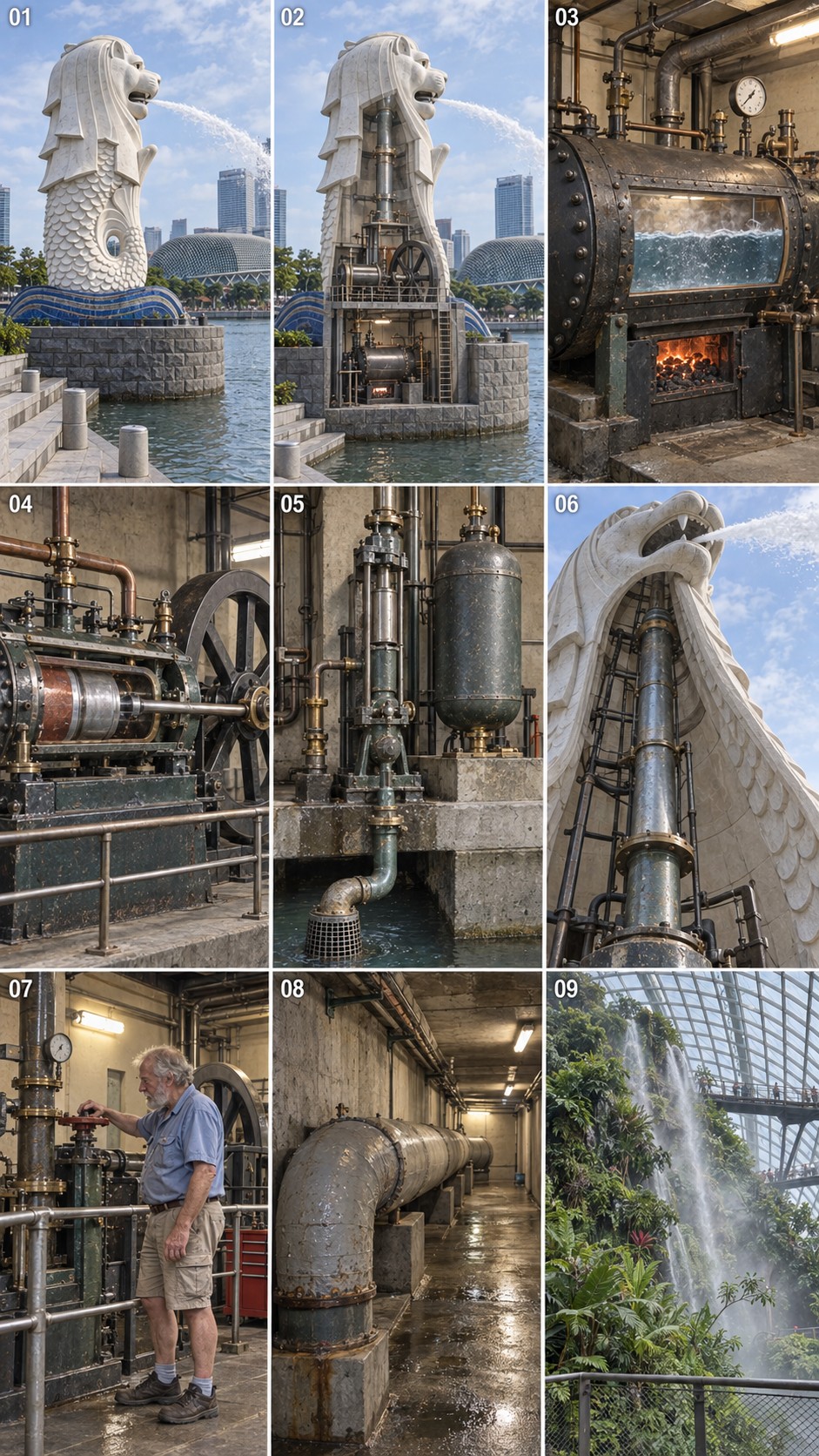
ChatGPT made the storyboard, which helped turn the joke into a route through the machinery. Boiler below, engine above, pump moving the water upwards. The first version still ends at Gardens by the Bay. We abandoned that ending; the picture survived.
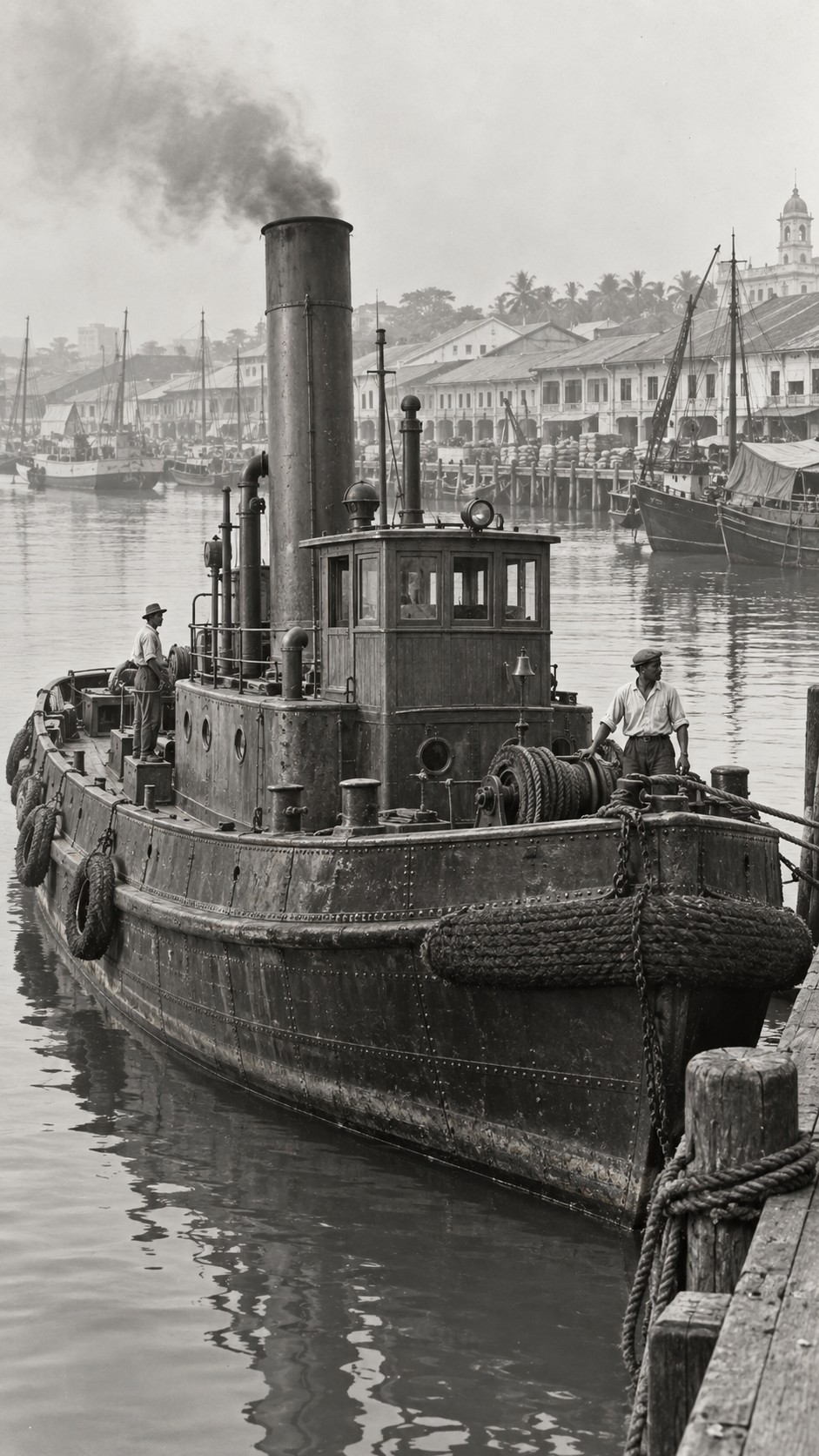
The tugboat needed a past, so we gave it one. We generated a harbour scene, then treated the film insert more like an old photograph: sepia, softer detail and a restrained move across it. This is an invented archival-style image, not something unearthed in a Singapore collection. A suspiciously crisp “old photograph” would have spoiled the effect.
The machine looked excellent. Then it moved.
I made the film with ChatGPT in Codex, using Astra, and Runway. Codex helped with the story, pictures, animation, editing and subtitles; Runway supplied video generation and the narration. There was plenty of direction from me along the way, mostly concerning things that had just fallen off.
We first tried the obvious approach: give Runway a finished picture of the engine and ask it to animate the mechanism. The prompt was quite specific. Keep the camera still. Turn the flywheel in one direction. Keep the connecting rod rigid. Make the piston follow the wheel.
The resulting machine had other interests.
These are the original test frames, not a new failure staged for this article. The metal looked lovely, but the linkage changed shape and the piston never delivered the convincing, connected cycle we needed. In another attempt, more of the picture stayed intact, but the mechanism barely did its job.
A few seconds of atmospheric machinery might have passed. Ours was supposed to be a close-up explanation of how the machinery worked. The moment you invite people to follow a rod from one joint to another, that rod has to remain the same rod.
So we built the moving parts
The useful change was to stop asking the video model to invent the motion. Codex wrote a small 3D mechanism in code and rendered it in Blender. Yes, actual Blender: there are editable scene files, cameras, lights, objects and an animation timeline.
Astra wrote the geometry and the movement rules. Blender rendered them. It was not a mysterious 3D engine running “inside” the chat.
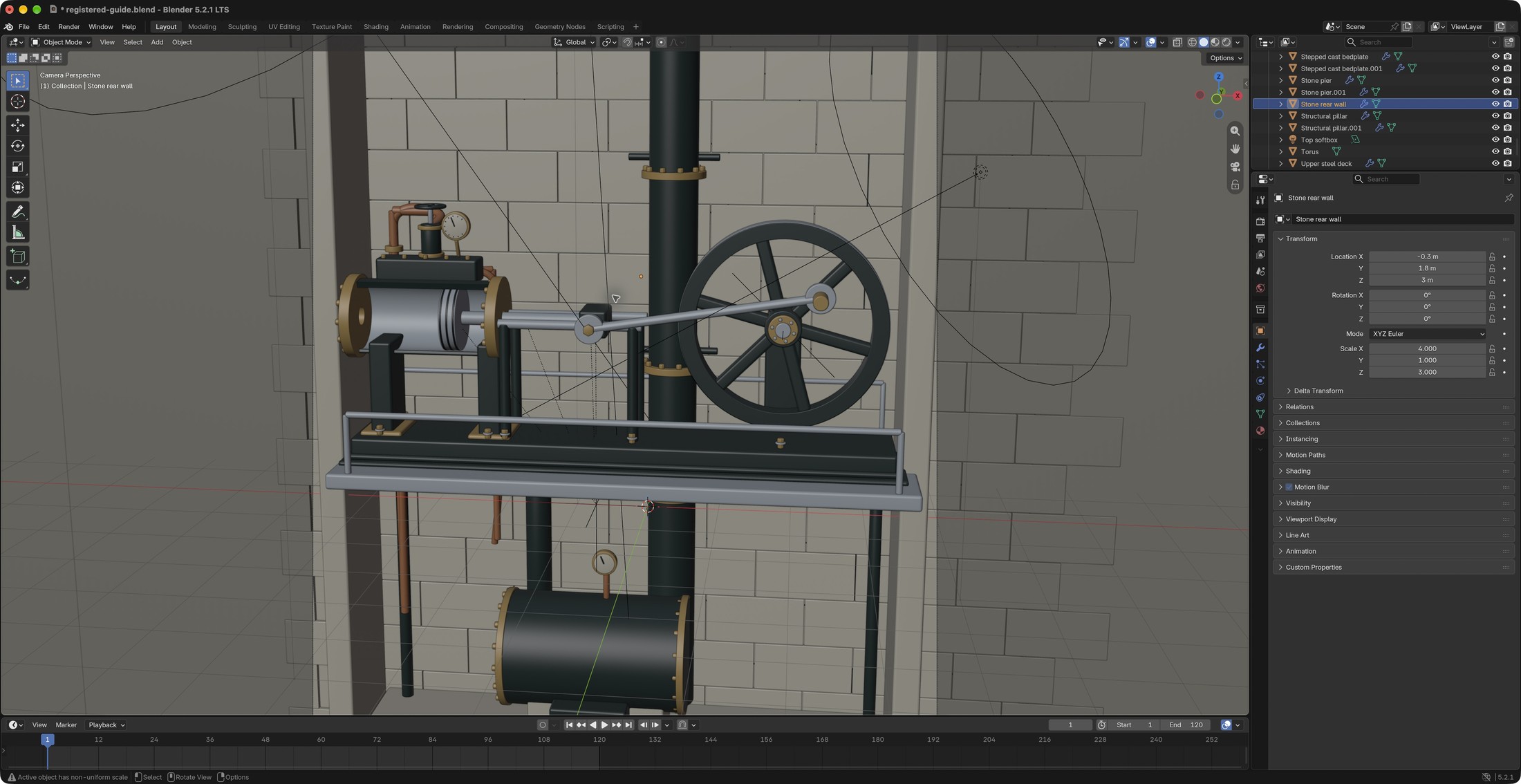
The wheel’s centre stayed fixed. A pin travelled around it. The connecting rod kept a constant length, so its other end determined where the piston had to be. We checked the joints throughout the cycle. This was a controlled animation of the linkage, not a full engineering simulation of a working steam plant.
The first version was visibly simpler than the picture I wanted. That was useful: we could see what was moving before worrying about how attractive it was.
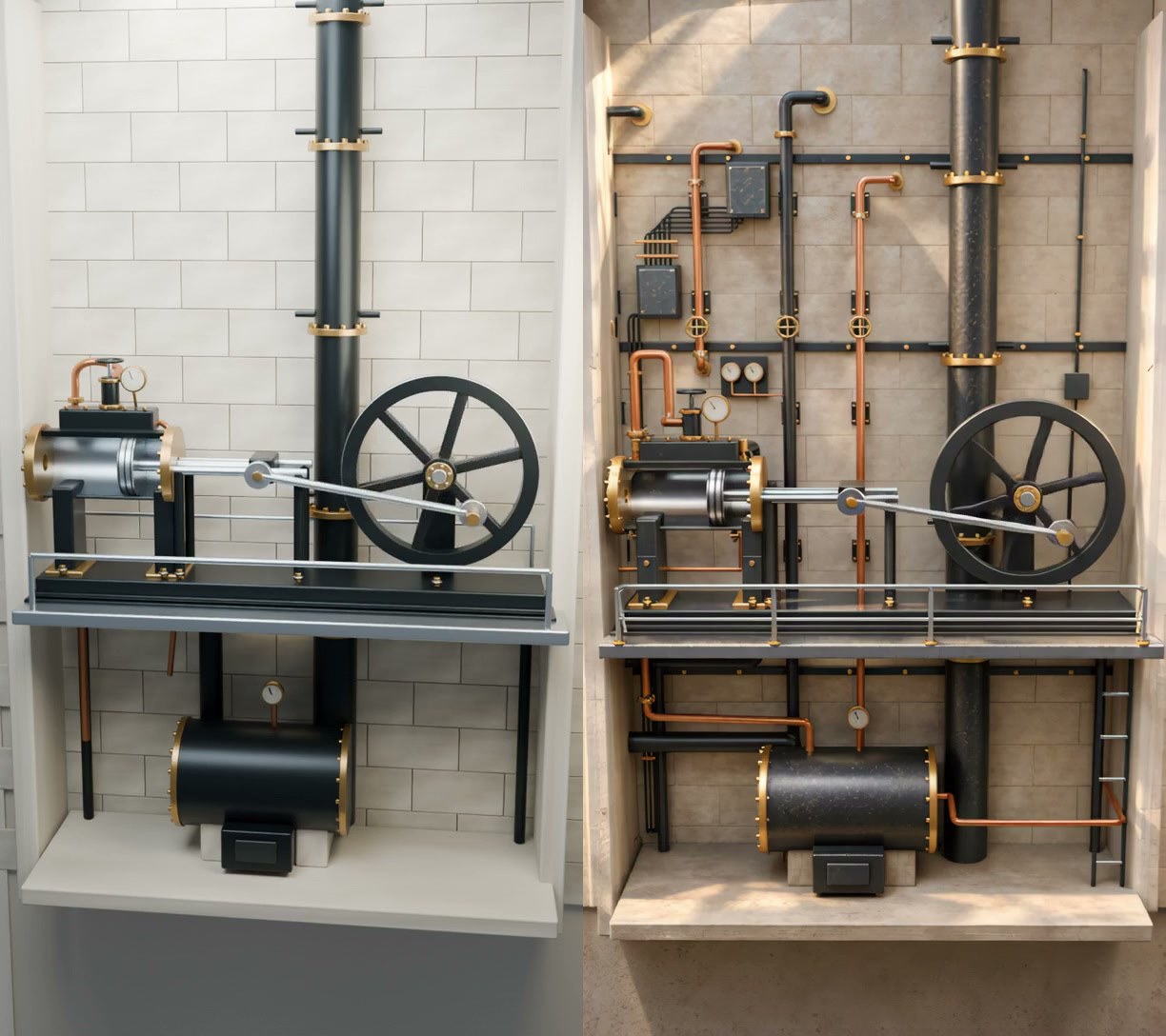
Next came the visual treatment. We aligned a more elaborate reference image with the 3D view, then sent the short motion guide and the styled frame to Runway. Now it had an example of the movement to follow, as well as a picture of the world it was meant to inhabit.
That got us much closer. It did not eliminate checking. Some texture and detail still changed, and a successful close-up did not automatically give us a convincing wider shot.
The comparison above spans several rounds of work: the early guides on the left, the later, more detailed shots on the right. It is not one miraculous pass through a filter. We added pipework, wall detail, cables and a coherent machine room, while trying to keep the motion we had already solved.
The pump loses an essential employee
The water pump was particularly good at looking plausible for half a second.
In one version, the rod pulled so far out that it appeared to leave its housing. Elsewhere, a pipe ended in a support instead of going anywhere useful. The cutaway showed water, but no convincing opening for it to enter or leave. A valve wheel floated without its spokes. The pressure gauge had no proper scale.
Then, while we were simplifying things, the broad piston disappeared.
It was a beautiful cylinder with a thin rod hanging into it. Unfortunately, we had asked for a piston pump. Removing the piston was a rather thorough way of simplifying it.
We went back to the model: a wide piston, a long enough rod, visible inlet and outlet passages, and pipes that continued around the supports. The water also needed to occupy the exposed volume of the cylinder, rather than looking like a decorative blue stripe.
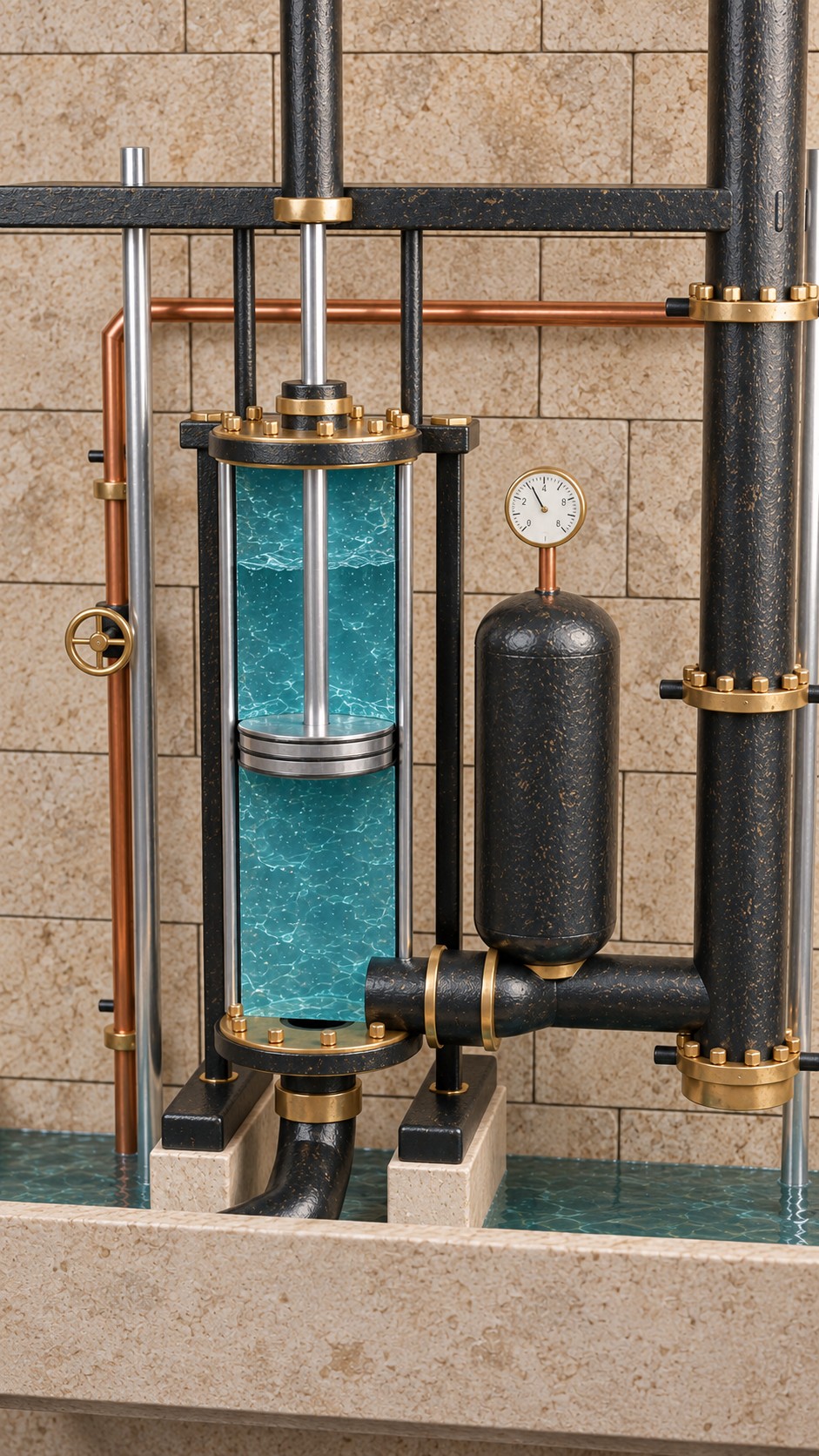
By this point I was doing quality control on machinery I had invented to support a joke about hotel laundry.
Arthur would not stop talking
The mechanic caused a different sort of trouble. I wanted someone who had spent years around this engine: an ordinary older man in a shirt and shorts, comfortable with the machinery, making a small adjustment and listening to it.
Some takes gave him an unconvincing screwdriver action. Others made the enormous flywheel rock backwards and forwards, as if his tiny adjustment had overcome all its inertia. We kept asking for a steady rotation, with Arthur adjusting a separate control.
Then he started moving his lips as though he had a speaking part.
Hiding his face was not a satisfactory fix: we were introducing Arthur, not filming the back of an anonymous maintenance worker. But a silent portrait could become unnaturally stiff. Eventually we gave him a small wave. Enough to make him feel present, without turning him into a second narrator.
Making it sound like a documentary
The voice had to sound interested in the mechanism, rather than mechanically interested. Early versions were too slow and too uniform. The Russian narration also needed several pronunciation corrections, including an unexpectedly long negotiation over the word for “hotel”.
The English version was an adaptation for an audience in Singapore, with its own narration and separately timed captions. We kept the captions as an editable layer, so changing languages did not mean generating the whole film again.
The music also needed work. We tried a marimba-led direction, raised it enough to carry the edit, and reworked the machinery sounds. The first repetitive steam puff did little for the scene; a quieter mixture of mechanical movement, steam and water gave the room more depth.
The edit got shorter and busier too. Tourists and the waterfront first, then the reveal, then close-ups and the imaginary archive photograph. Long stretches of pipe were cut down. The Fullerton needed a real view of the actual building, in light and colours that belonged in the same film.
What began as a silly idea about British plumbing became a small production full of very specific decisions: where a pipe ends, how a wheel turns, when a man waves, whether a subtitle sits too high.
The Merlion still has no steam engine. Arthur is imaginary. But if anyone installs that electric pump, I would like them to check with the laundry first.
Which part of this imaginary Merlion would you keep?
Loading responses…