The Lake Above the Gardens
The strangest thing about the lake was where you would sit to look at it. Underneath, with a cup of coffee.
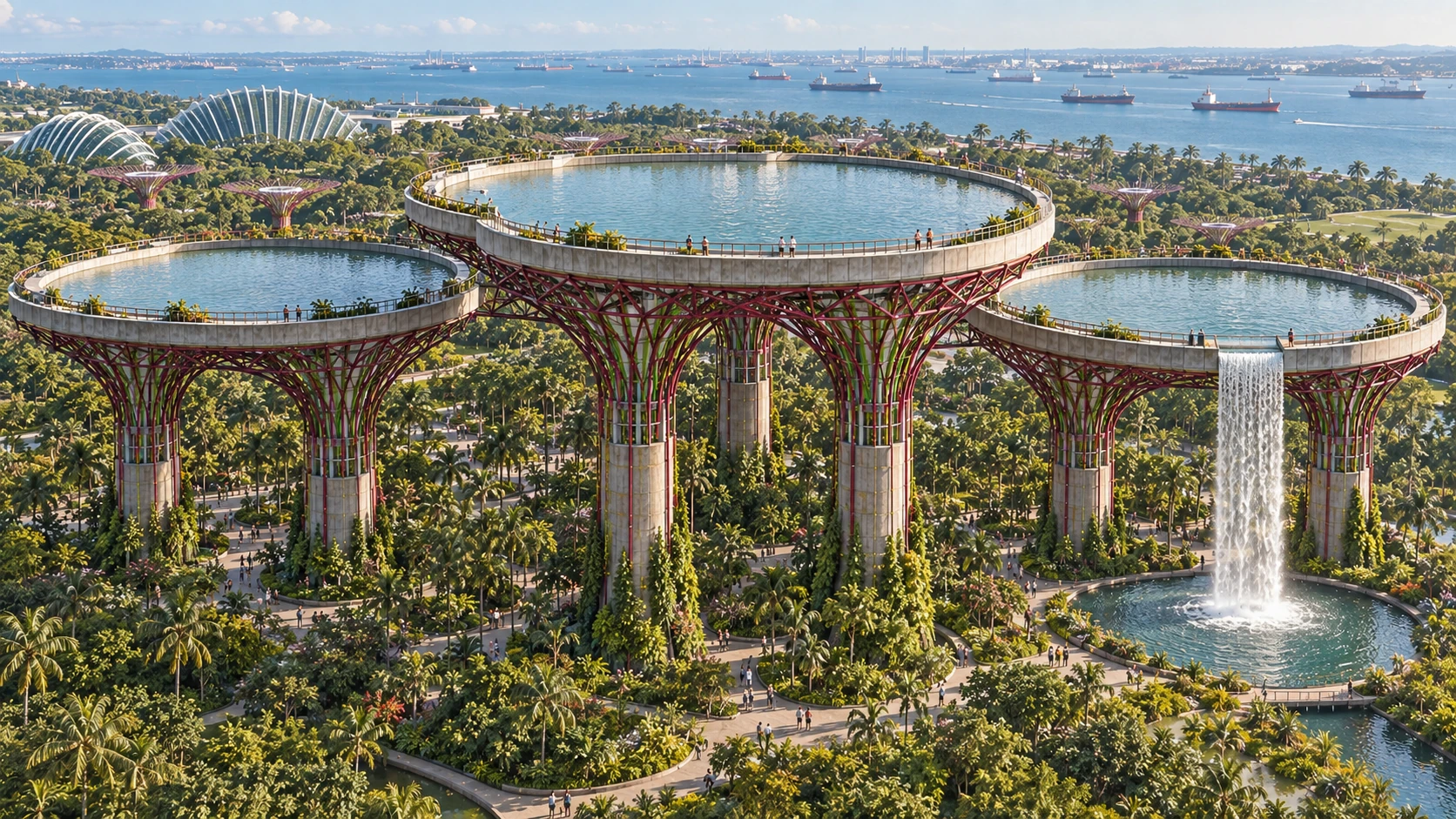
The water would spread across broad, shallow bowls above the garden. Ferns, footpaths and café tables would occupy the space below. At the edges, waterfalls would descend into their own pools, close enough to hear from your chair. The view came with a substantial amount of water overhead, but otherwise it was a perfectly ordinary place for breakfast.
The supports were the familiar part: concrete trunks opening into steel branches. Seen this way, the Supertrees begin to look less like trees and more like something waiting for its roof. The lake was meant to be that roof. Each basin would sit on a group of columns, sharing its load across the garden.
A park with a lake for a roof
One enormous slab would have left a rather gloomy park. The proposal instead broke the water into separate basins at different heights, with gaps for daylight between them. Looking down, you would see a chain of lakes. Looking up, you would see the underside of a landscape.
The branches had a practical role in this arrangement. They spread the load from the bowl towards the concrete trunks, rather as the ribs of an umbrella distribute the weight of its fabric. Except that the fabric, in this case, was a reservoir. Fine steelwork and a thin-looking rim could make the whole thing appear surprisingly light. The foundations would have to deal with what the view left out.
Above, beneath, beside
Three ways to meet the same lake.
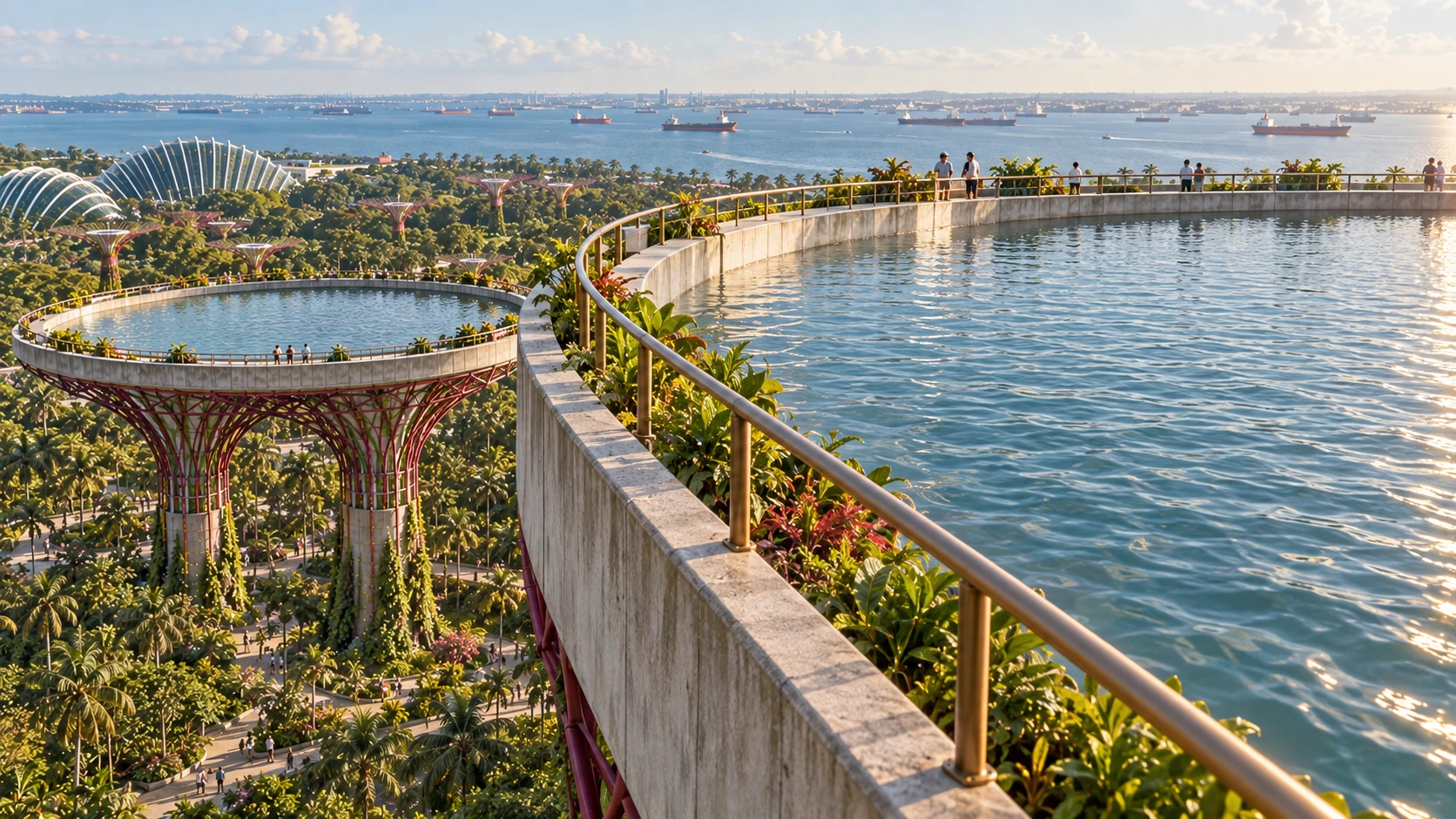
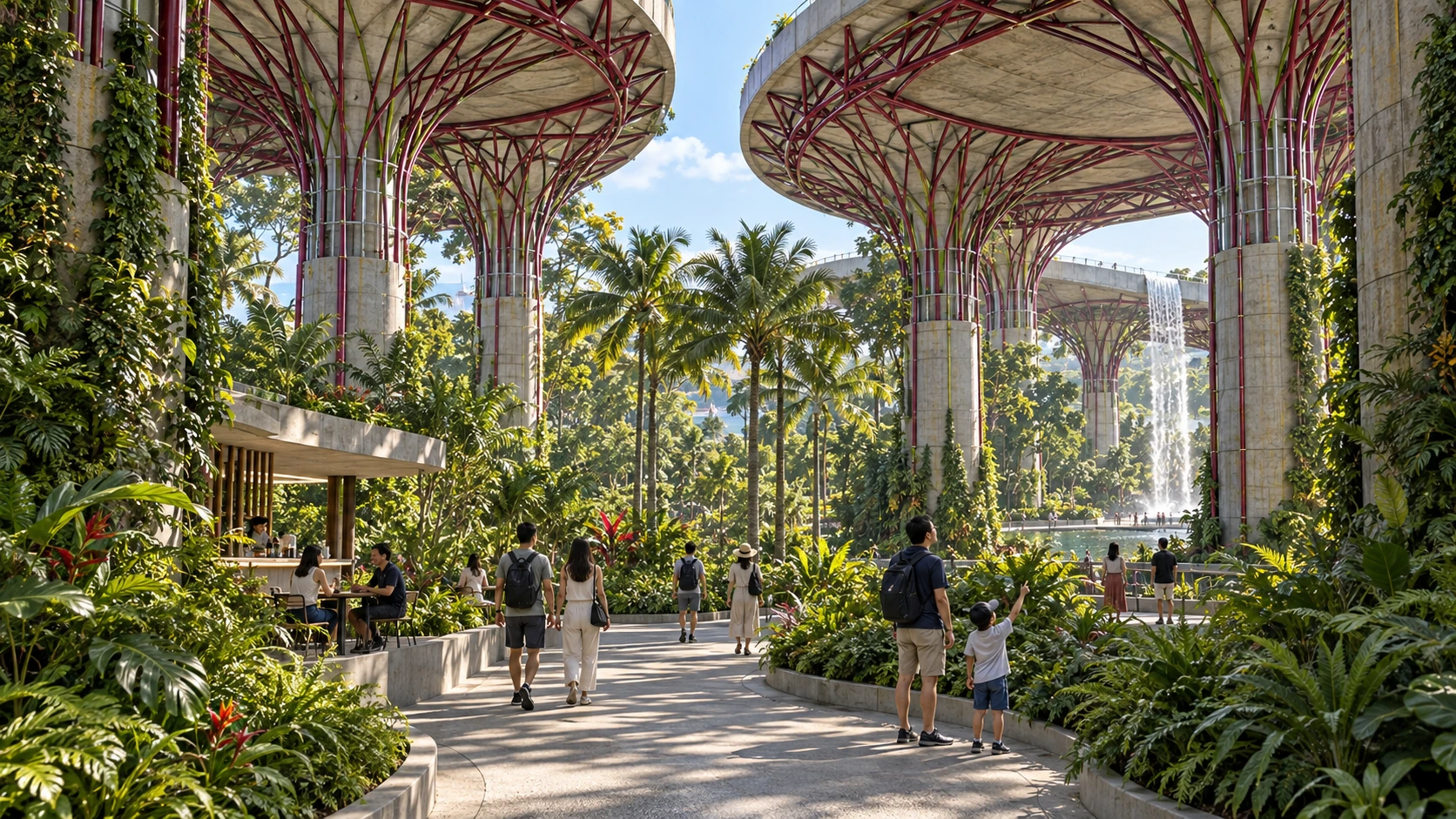
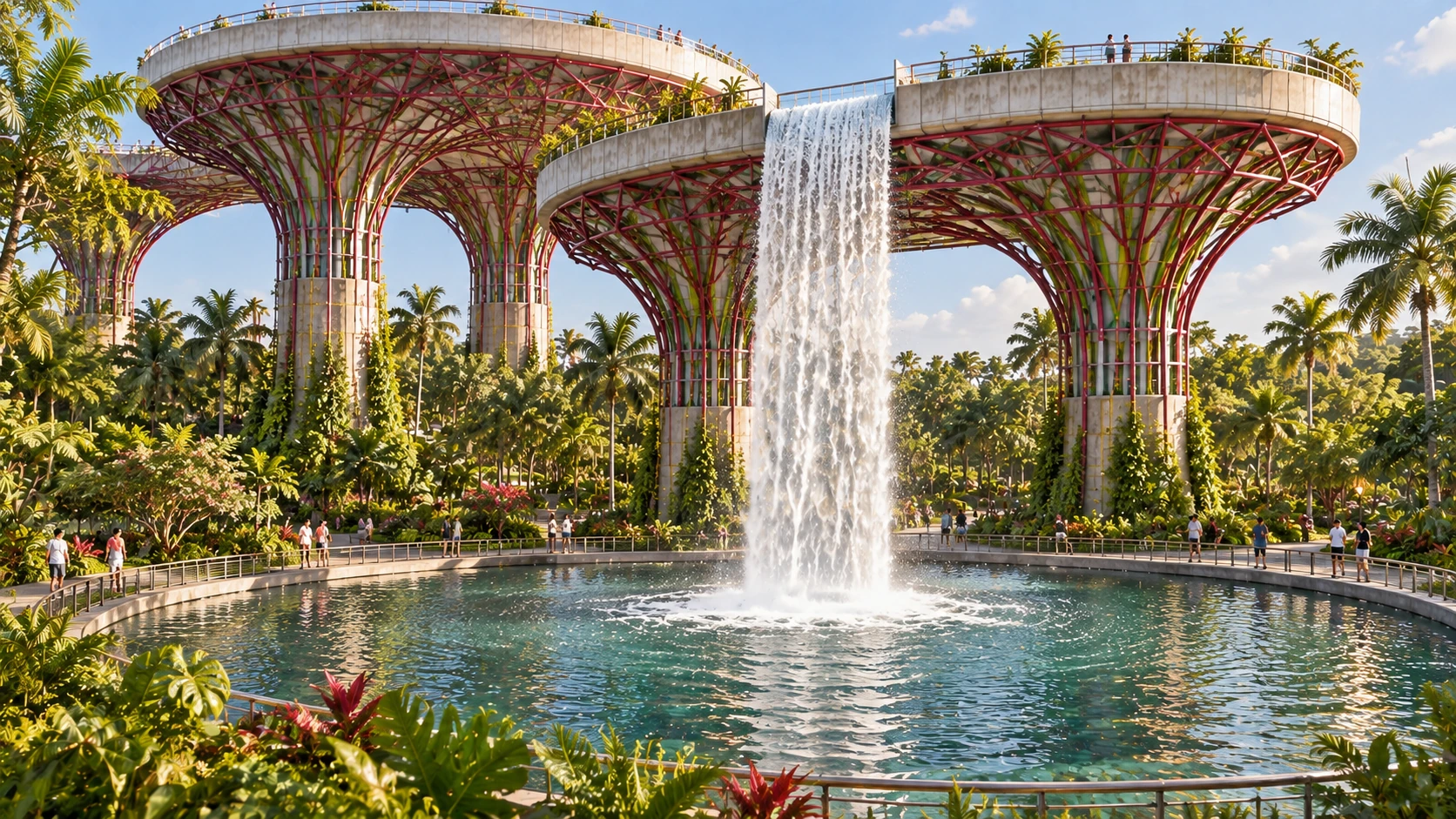
Scroll across for all three views.
01 / Follow the water
The waterfall is only half the journey
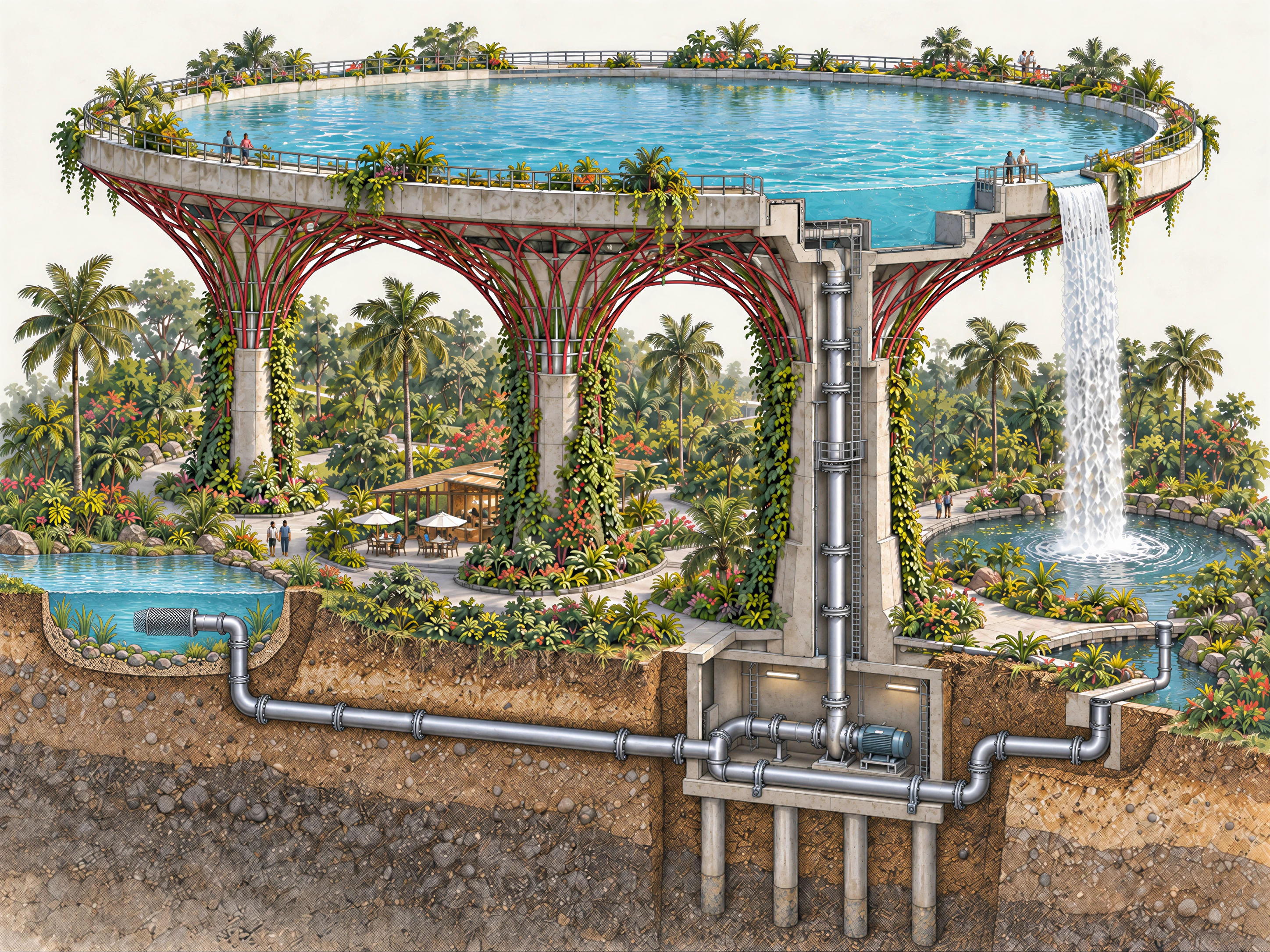
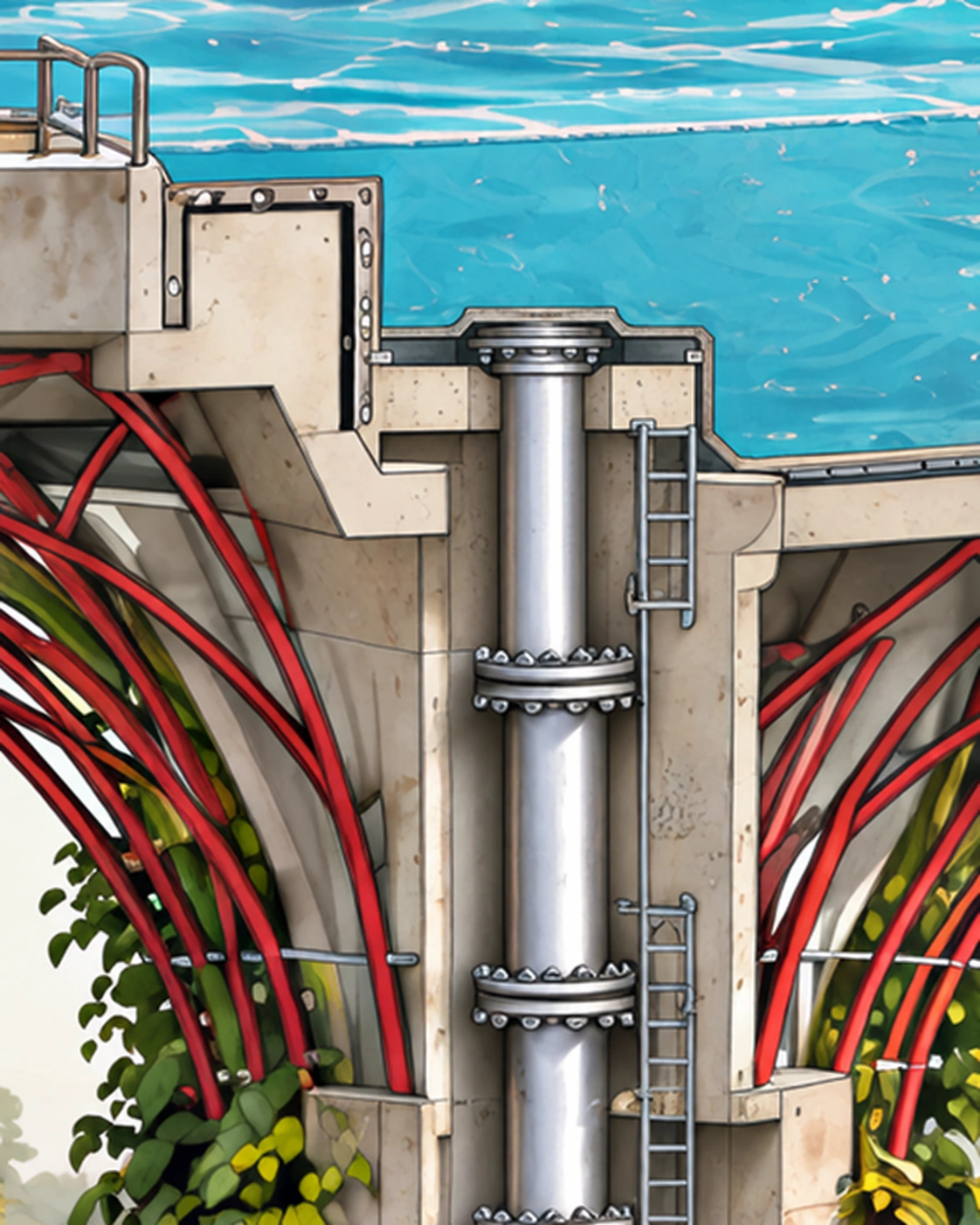
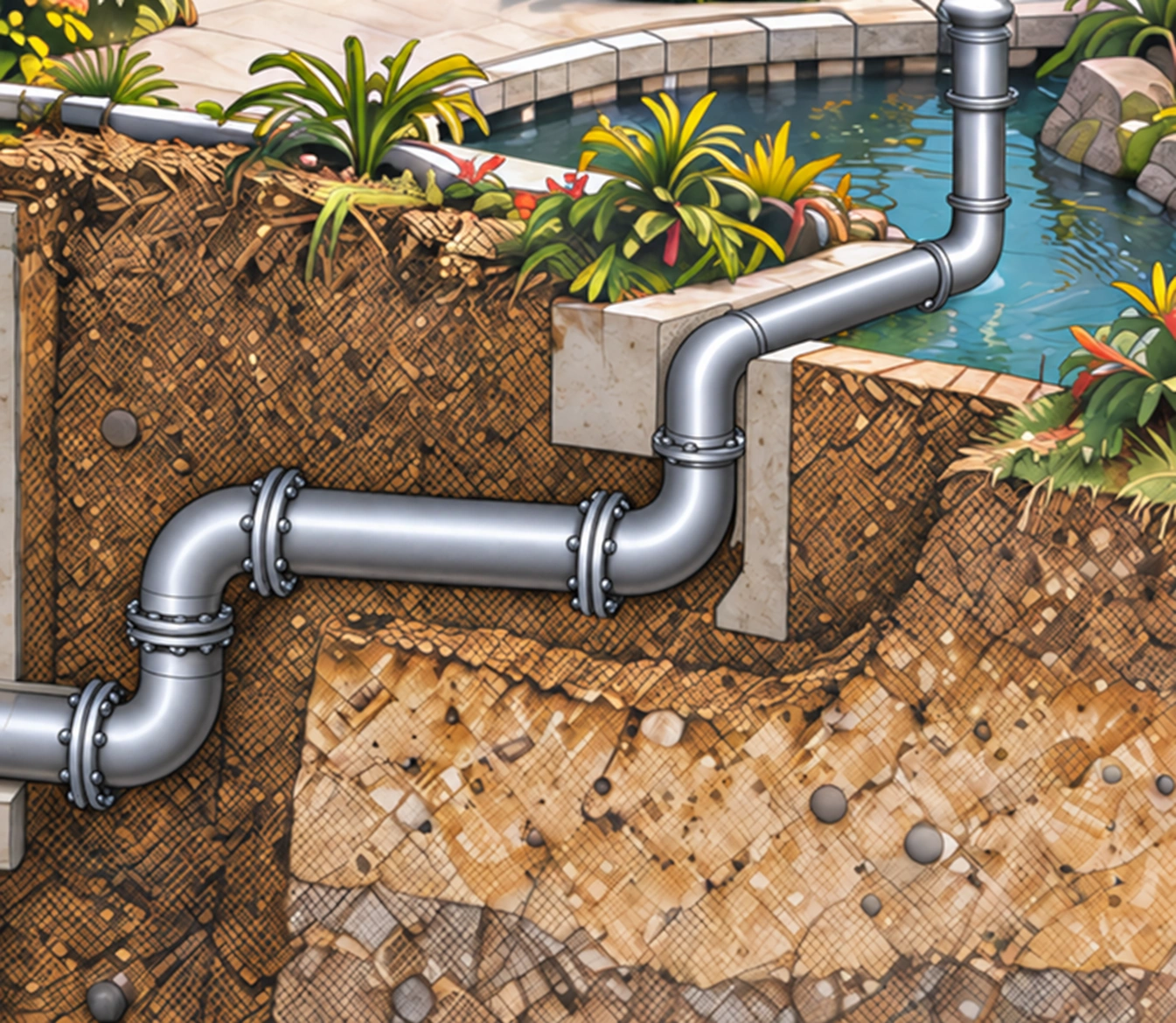
A nearby reservoir would supply the system. Water would pass through a screened intake and along a buried pipe to a pump in a dry underground chamber. From there, a steel riser inside a column would carry it to the basin overhead. The pipe could disappear inside the architecture; its job could not.
At the other end, water spilling over the rim would land in a receiving pool. A separate return line would bring it back to the pump’s inlet. That is the pipe on the right of the illustration: the way home. It joins the incoming supply before the pump, completing the circuit instead of disappearing into the ground.
02 / The weight of the view
Water gets heavy quietly
Stand beside a shallow pool and it is easy to underestimate what is there. A cubic metre of fresh water has a mass of roughly a tonne. Spread it over one square metre and you have a layer one metre deep. Spread that layer across a much larger bowl and the arithmetic continues, square metre after square metre.
The water does not replace the weight of the structure. It arrives in addition to the concrete shell, steel branches, walkways and everything else the columns already carry. Making the basin broad and shallow helps the appearance. It does not make the contents weightless.
03 / Below the flowerbeds
The ground had a longer memory
The next part of the story happened beneath the paths. The site had been built up from the sea. The neat surface of a reclaimed landscape could conceal layers with very different behaviour: fill above, older seabed below, and soft marine clay that would respond to a new load over time.
Clay is not a solid block with a convenient breaking point. It contains water in tiny spaces between its particles. Under added load, some of that water can gradually drain away and the soil can compress. The surface may look finished while movement continues underneath. Understanding how much, how quickly and how unevenly it will move is part of designing the foundations.
Deep piles carry loads down into the ground, transferring them through their sides and their tips. But drawing a long line beneath a column is not the same as knowing how a foundation will behave. Ground conditions, the pile group and the load all matter. That was the point of the test columns: find out what the ground would do before giving it a lake.
The awkward word is “differential”
The test supports in this story did not settle at the same rate. That difference was the problem. When neighbouring supports move together, the structure above can sometimes accommodate the movement. When one moves more than the next, the geometry between them changes. Connections have to deal with it.
For a water-retaining structure, distortion brings a particularly unhelpful possibility: leakage. A joint that has to remain watertight is also being asked to tolerate movement. The issue is not simply whether the columns are strong enough. It is whether the whole assembly can carry its load while keeping the water where it belongs.
The detail that matters
Watch the joint, not just the columns.
A very expensive way to make a garden
The lake could have demanded stronger foundations, more work below ground and a much larger budget. There comes a point when the engineering solution changes the proposition. The attraction was a garden with water floating above it. The bill was becoming a foundation project with a garden attached.
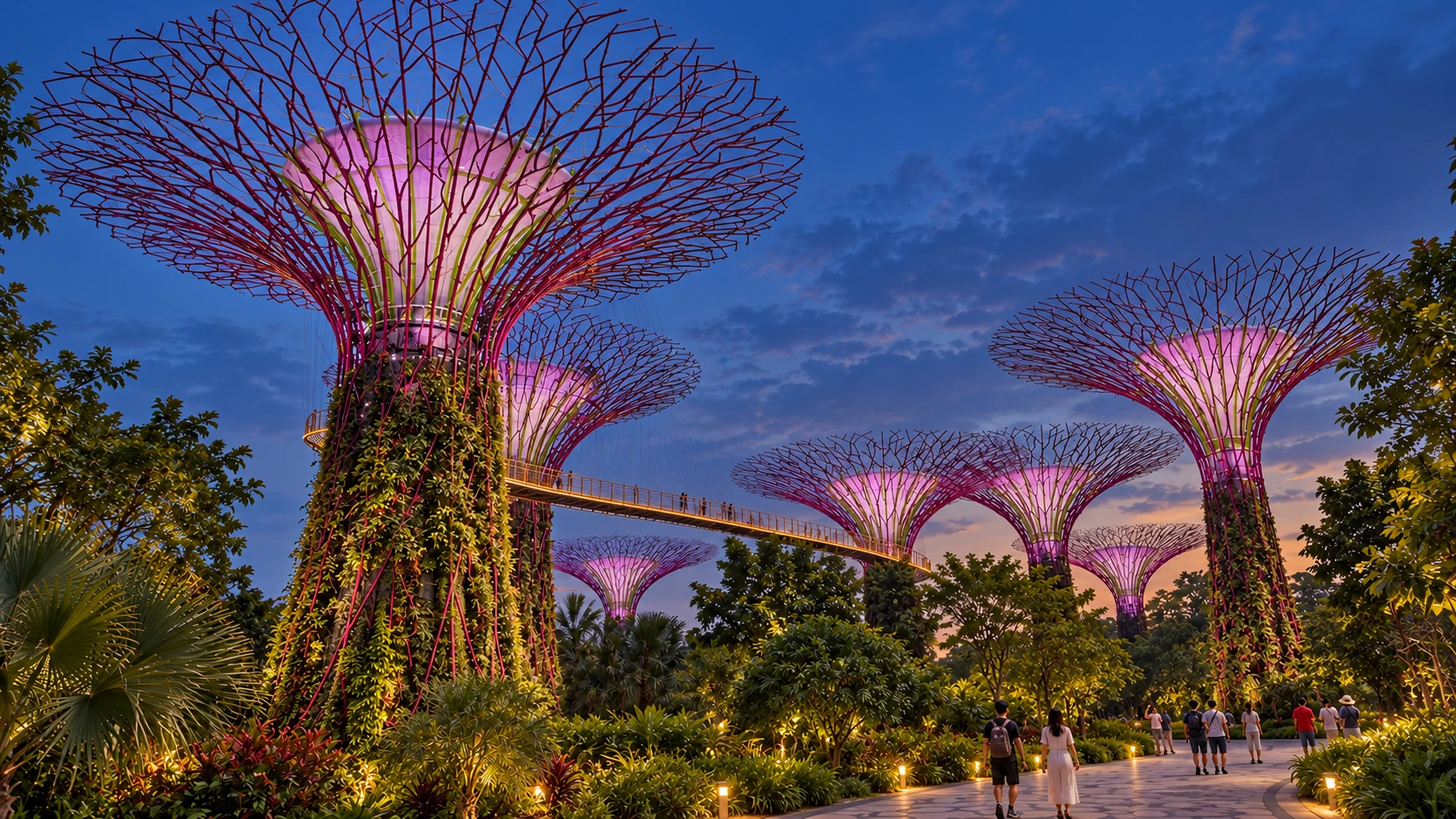
The reservoirs were abandoned. The columns remained. Their branches still offered a useful framework, and their height still gave the park something extraordinary to look at. Planting panels could climb the trunks. Lighting could fill the canopies after dark. The water was the heavy part of the idea; the silhouette could stay.
Another version of Singapore
And then they called them trees
It is a satisfying explanation for those steel branches: a lake was too much to carry, so the city planted flowers on what was left. It also belongs to an alternative Singapore. The overhead reservoirs, the test columns and the abandoned scheme are the story we invented. The weight of water and the foundation problems are real engineering ideas.
The actual Supertrees have their own quieter machinery. Some harvest solar energy; others help exhaust air from the conservatories. A garden can conceal quite a lot without hiding a cancelled lake. The real systems are worth a look, too.
Watch the story
The lake, from above and below
The complete film, with English, Russian and Chinese language options on YouTube.
A little further below the surface
The real science behind the detour: water density, Fort Canning’s underground reservoir, and the Gardens’ working environmental systems.
Would you have coffee beneath that lake?
Loading responses…