Winter, delivered: inside an imagined Sentosa dome
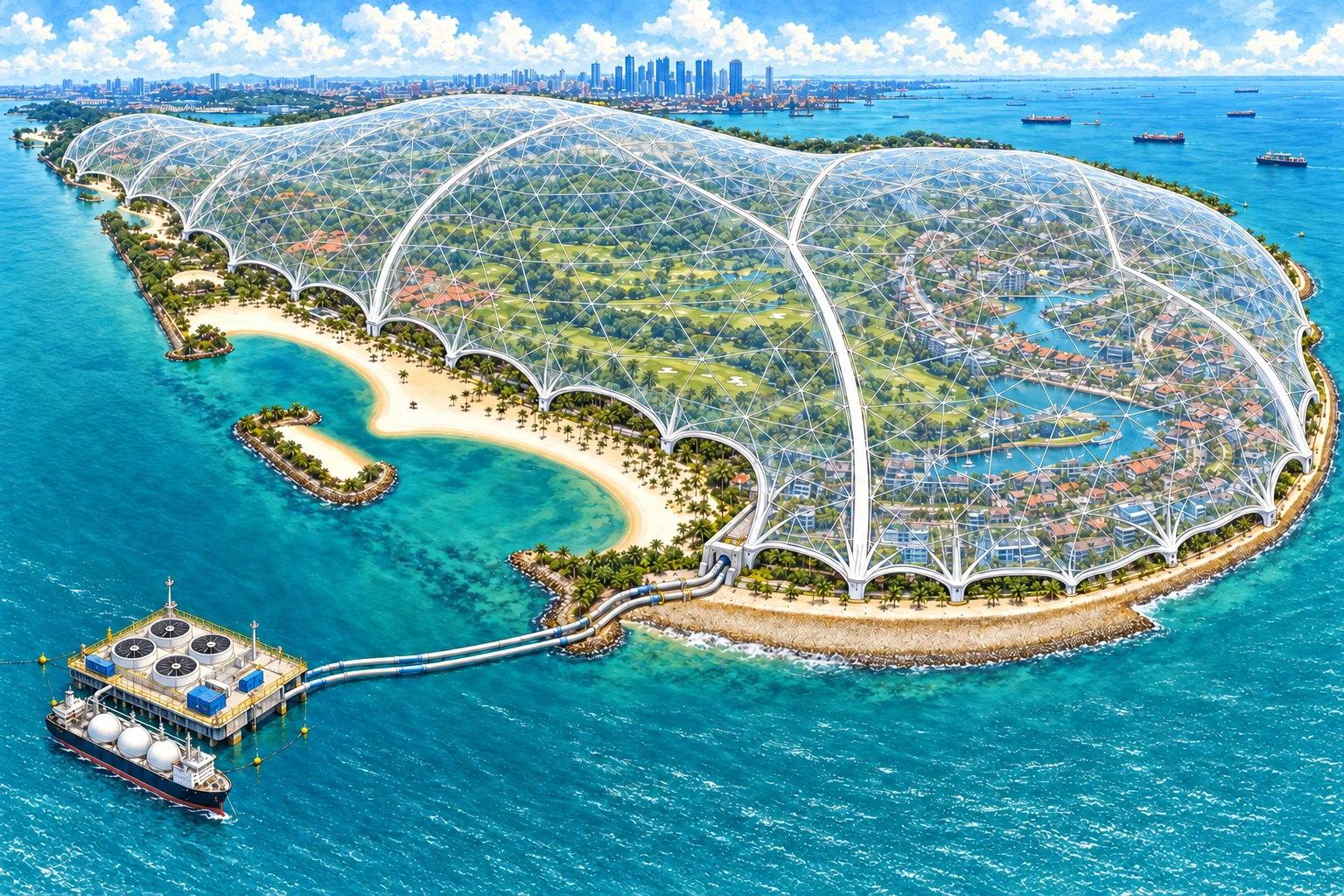
The machinery behind a week of snow on Sentosa.
The ship would arrive before New Year carrying a week of winter. Most of the interesting equipment would be needed before the first snowflake.
01 / Site plan
An island with a service entrance
Sentosa, the resort island just off Singapore’s southern coast, would become one large controlled interior. Its hills, low-rise buildings and trees would sit beneath a transparent roof shaped around the whole main island. The sandy beaches and small offshore islets would remain outside. In this fictional version, tall waterfront condominiums give way to low landscape so the roof can descend to its coastal supports. Across that boundary, December would carry on as usual.
The obvious object is the dome. The less obvious one is the floating platform beside it. In our scheme, that is where the pumps, heat exchangers and cooling machinery live. A pair of insulated mains links the platform to the island. One supplies chilled fluid; the other brings it back after it has collected heat. The ship gets its own berth beside the plant.
Read the island by system
Real coastline · imagined systems
Ochre lines · roads
Mount Faber Line H · HarbourFront S · Sentosa
Sentosa Line 1 · Siloso Point 2 · Imbiah Lookout 3 · Sensoryscape
The two lines have separate stations. Walk between S and 2. Cable-car network ↗
Map data © OpenStreetMap contributors. The roof, utilities and berth are fictional proposals; machinery symbols are enlarged for clarity.
The island before the invention. The coastline, roads and building footprints come from geographic map data. Siloso, Palawan and Tanjong lie along the southern shore; Sentosa Cove occupies the southeast. The harbour and mainland lie to the north.
Roof & supports. The shell follows the full main-island coastline, with sandy beaches cut out of its footprint. Heavy primary ribs carry a finer triangular grid; the eastern and northern lobes are covered too. Ochre circles mark the branching columns at the ends of the main ribs. Offshore islets remain outside.
Two pipes, one circuit. Blue takes chilled fluid inland; terracotta returns it to the plant. Both have a destination. The branch lines feed heat exchangers in the columns.
A separate water system. Rain and snow use treated water, not cooling fluid. Collection drains bring meltwater back for treatment and reuse.
Roads and two cable-car lines. Ochre lines trace the road network. The violet Mount Faber Line reaches Sentosa via HarbourFront. The burgundy Sentosa Line stays on the island: Siloso Point → Imbiah Lookout → Sensoryscape. A short walk connects the two lines. In our fiction, the mainland line crosses the roof through an airlock; the internal line runs beneath the shell.
02 / The cargo
The ship brings somewhere
for heat to go
There is no useful pipe for pumping “winter” ashore. The cargo in the film is a frozen thermal-storage material. As it thaws, it absorbs heat. The vessel would act as an extra cold reservoir connected to the island’s cooling system for the snowy week.
In this expanded version of the scheme, the material stays inside insulated tanks aboard the ship. A heat exchanger separates it from the circulating fluid. The cargo does not end up in the rain nozzles or the sea. Once its useful reserve is spent, the ship leaves to have that reserve restored.
Thermal storage already works on this principle. A material is cooled in advance and used later to absorb heat; some systems use the transition between solid and liquid. Transporting enough of it to give Sentosa a snowy week is the fictional leap. The film leaves the material unspecified; its melting range would have to suit the intended cooling temperature.
01 / Storage
The winter ship
The frozen reserve stays aboard. It absorbs heat as it thaws, then travels away to be charged again.
02 / Connection
Two separate loops
A heat exchanger passes heat between the ship’s storage circuit and the island circuit. The fluids do not mix.
03 / Plant
The floating utility
Pumps keep fluid moving. Refrigeration equipment rejects heat outside the dome, with extra help from the ship.
04 / Delivery
Inside the column
A local heat exchanger transfers heat from the indoor air to the fluid. A warmer return pipe closes the circuit.
Stored energy equals the mass of material times its latent heat of melting. This describes the phase-change portion only; it is not a sizing calculation for the island.
A rechargeable winter
Connected to the island
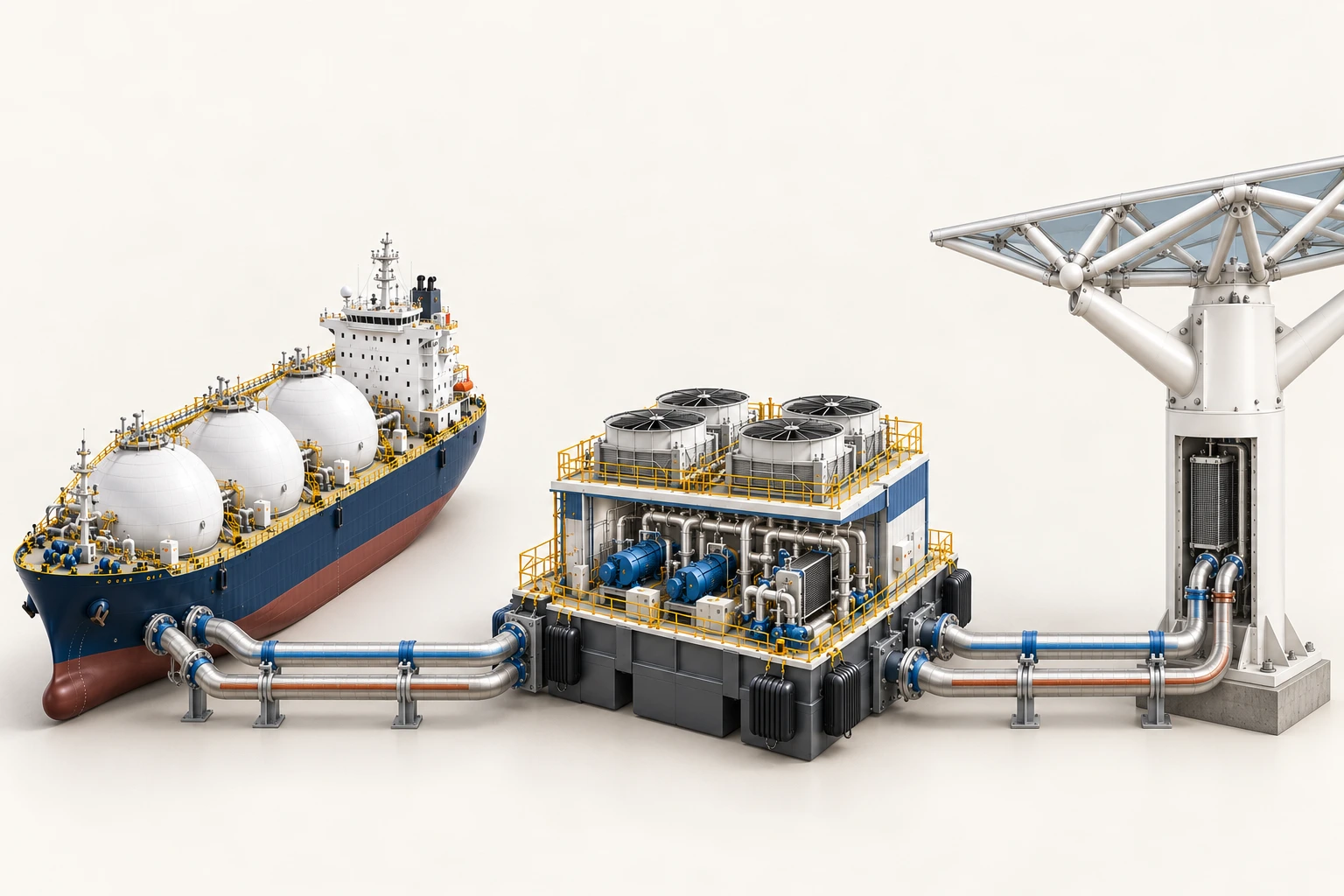
Heat moves out; the cold reserve is used up. The ship’s material thaws behind a heat exchanger. The island’s circulating fluid stays in its own loop.
Blue → chilled supplyTerracotta ← warmer return
Both pipes can be cold to the touch. The moving highlights show direction, not measured speed or temperature.
Follow the return pipe and the whole idea becomes easier to read. Inside the columns, heat passes from the air into the circulating fluid. That fluid travels back to the offshore equipment. The plant, with electricity supplied to its machinery, rejects heat outside the enclosed island. During the snow season the ship takes some of the load.
Moving the machinery offshore buys space in the story. It does not make the energy bill disappear. Nor does storage produce free cold: it separates the time of charging from the time of use. The return voyage belongs in the system diagram as much as the delivery.
03 / Hardware
The roof begins
with a very good grip
From the beach, the roof would look almost weightless. Up close, it would be a succession of quite substantial joints. Arches and branching columns support a network of tensioned cables. The cables terminate in metal sockets; those sockets need a load path back into the main structure.
The anchor shown here uses two steel cheeks and a pin through the cable’s eye. The pin transfers force into the bracket; the bracket transfers it to the rib. Beside it, a different clamp holds the edge of a transparent cushion against a gasket. Pulling on a structural cable and gripping a thin membrane are different jobs, even when they meet at the same junction.
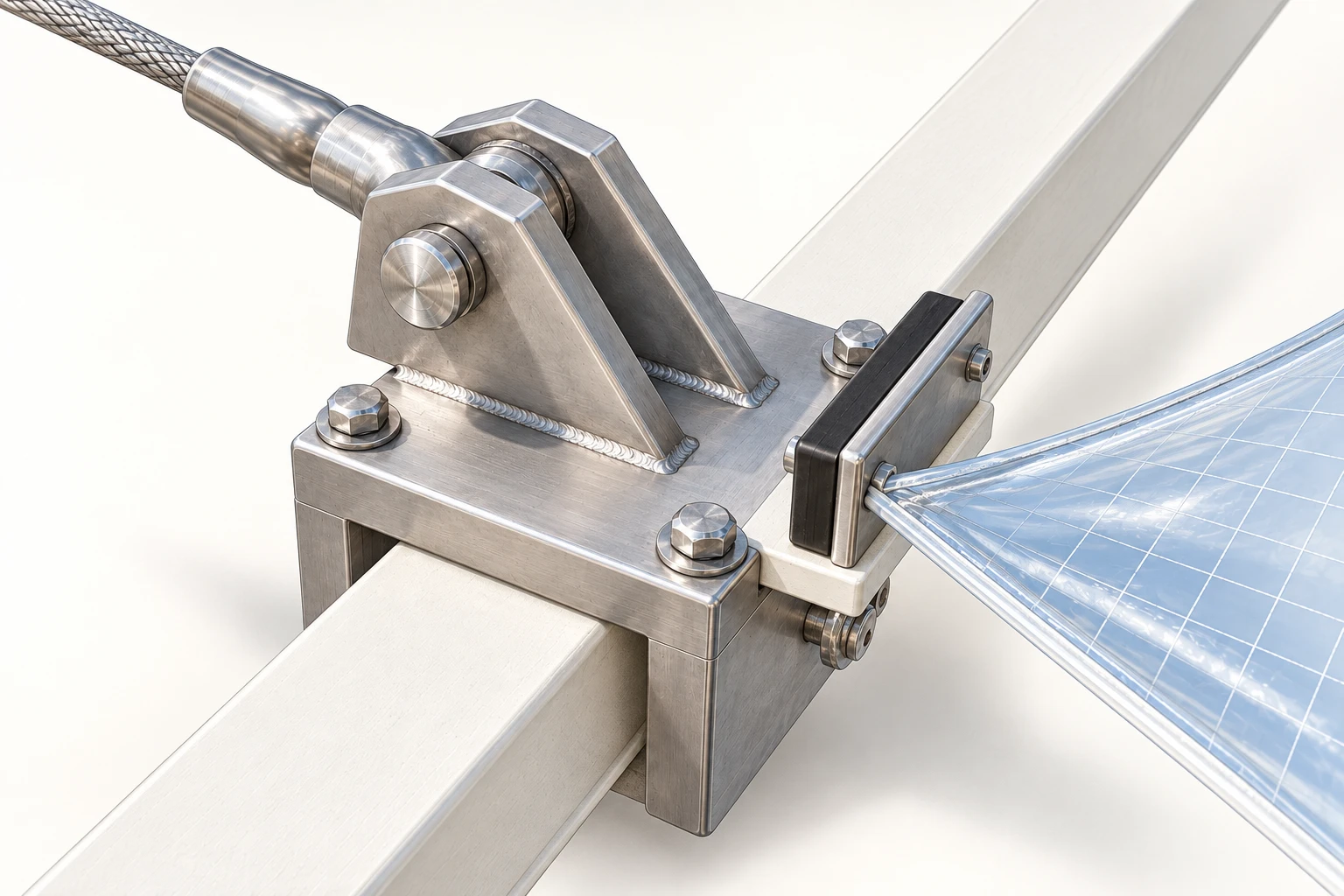
1Cable socket & pinThe tension cable meets the steel bracket through a pinned eye.
2Saddle & ribThe bracket carries the load into the main supporting member.
3Panel clampA separate gasketed grip holds the flexible cushion edge.
Material study
Quartzil: a roof
with air inside
Quartzil is the film’s invented lightweight composite: flexible transparent layers with fine reinforcing mesh. The air spaces are part of the cushion; they are not the ducts that deliver cooled air to visitors.
For this expanded scheme, we would divide the roof into individual cushions with accessible edge clamps. A damaged panel could be isolated and replaced without treating the whole island as one sheet of wrapping.
There is a real construction analogue in ETFE foil cushions: multiple foil layers, sealed edges, frame attachments and a low-pressure air system. Quartzil’s mesh, name and island-wide application belong to our fiction.
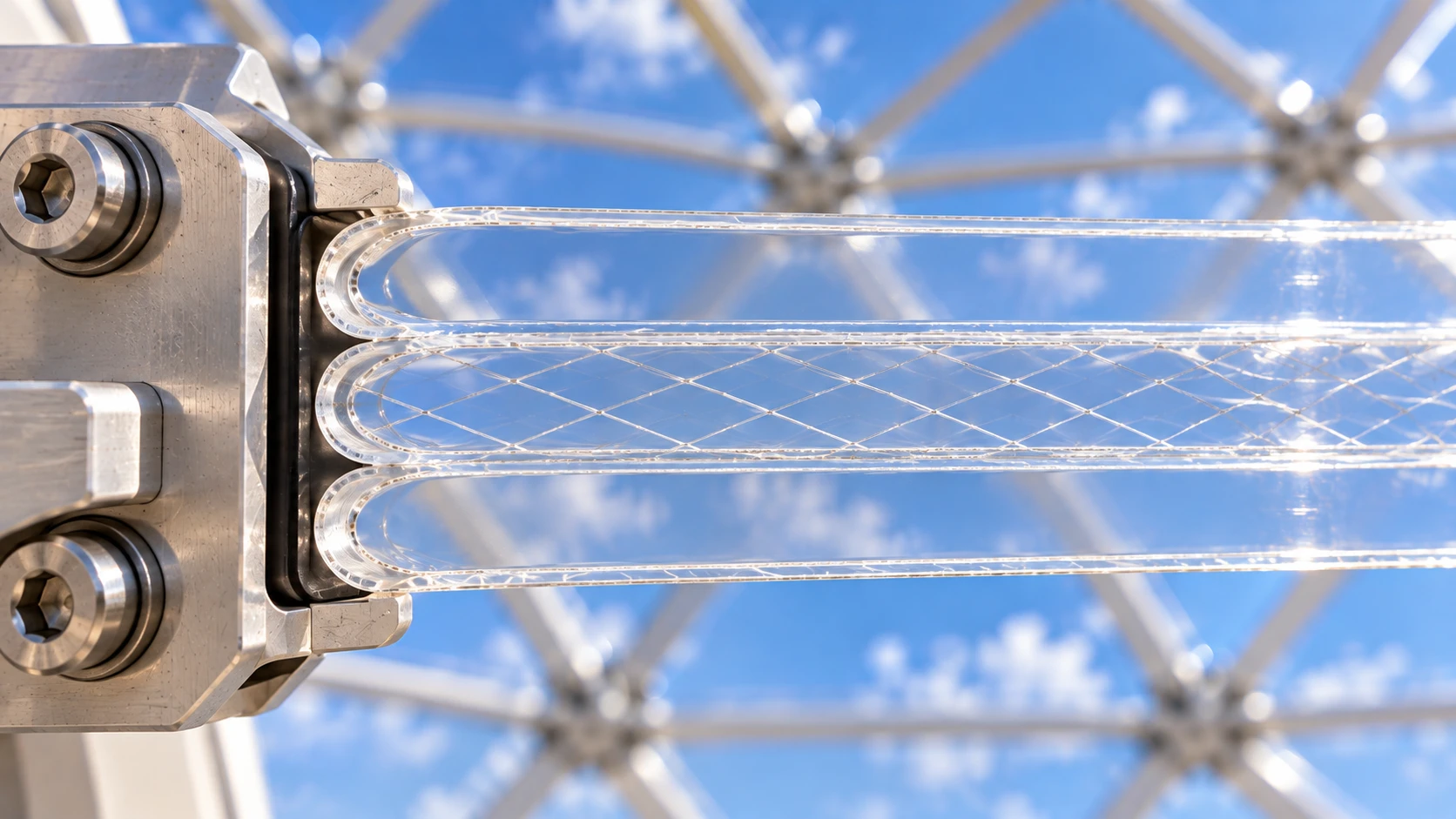
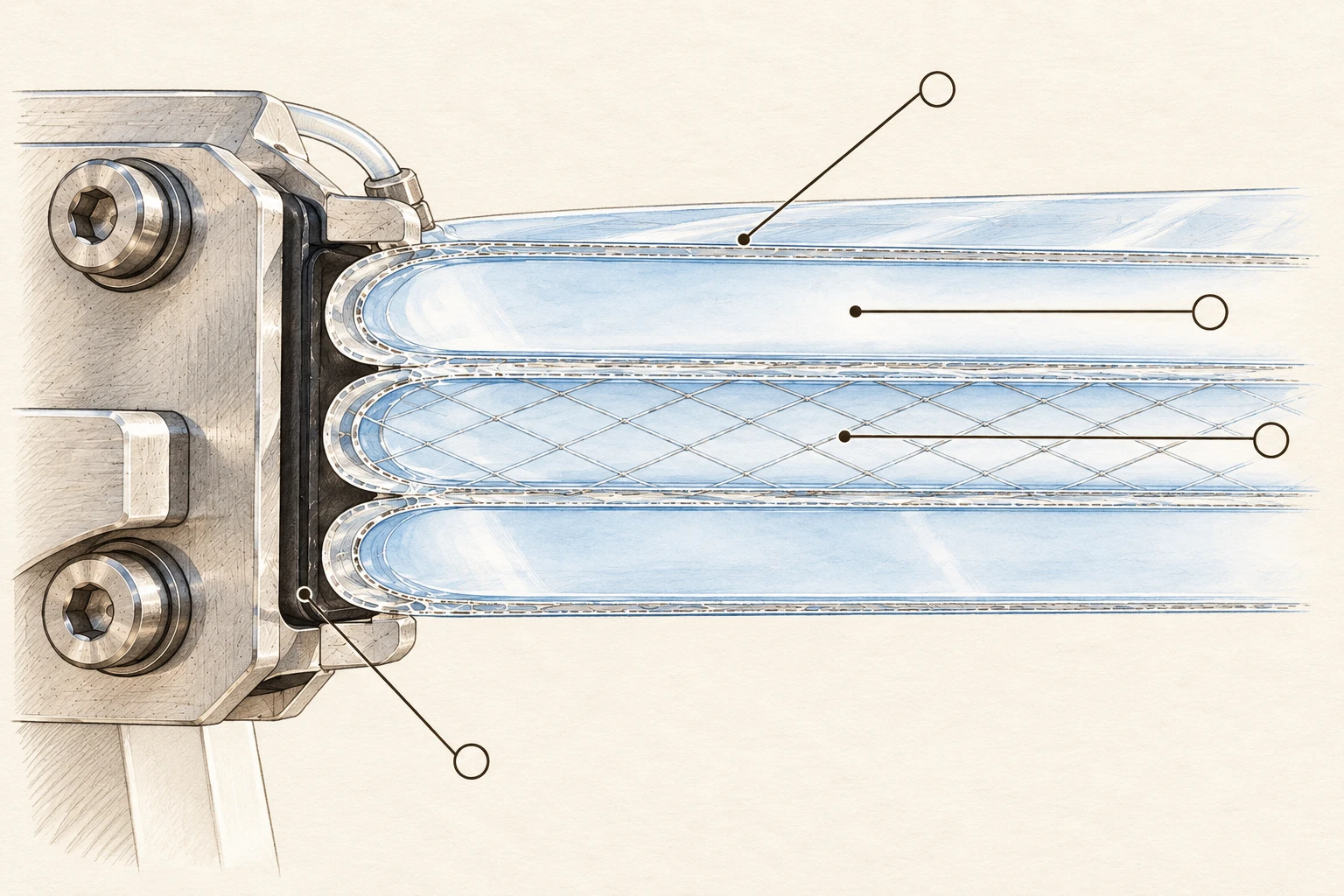 Membrane skinsAir spacesReinforcing meshSealed edge
Membrane skinsThin transparent faces enclose each shallow cushion.
Air spacesThe closely stacked cells separate the indoor and outdoor surfaces. They do not carry the island’s cooling fluid.
Reinforcing meshThe fictional Quartzil layer gives the film its fine diamond pattern.
Sealed edgeA gasket and bolted clamp gather the soft layers into a replaceable panel.
Heat flow grows with roof area and the temperature difference. The overall heat-transfer coefficient, U, describes the assembly. This simplified steady-state relation excludes sunlight, air leakage and the energy needed to remove moisture; Quartzil has no measured U-value.
04 / Weather, on the inside
Before snow comes water
A lower temperature setting would only be part of the operation. The tropical air carries moisture. Trees and visitors add more. Cooling a humid space means managing that water too; temperature and humidity are separate demands on an air-conditioning system.
That gives the winter programme a sequence. Prepare the air and the surfaces. Bring in the ship’s extra reserve. Then allow the snow chambers to release their crystals into conditions where the snow can survive. In the film, the roads are heated and meltwater is collected, cleaned and used again. The snowy week needs a drainage plan.
01
Prepare
In this proposed operating sequence, air handling reduces excess moisture and cools the enclosed space before snowfall begins.
02
Make weather
Dedicated chambers form and release ice crystals. Rain nozzles have their own treated-water feed, separate from the cooling circuit.
03
Collect
Heated roads keep a clear route. Drains gather meltwater for treatment and reuse; the cold reserve is gradually consumed.
The entrances would interrupt this carefully arranged interior. Cars need to cross the boundary, so the film gives them enclosed approaches and air curtains. Cable cars get a transparent airlock of their own. Every opening adds another place where the controlled interior meets the tropical air. The entrance is part of the weather machinery, even when it looks like a road.
The ordinary jobs would continue through every season: inspecting the roof joints, keeping drains clear, maintaining pumps and preparing the next delivery. The island could change the weather for its visitors. Its maintenance team would still have a fairly familiar working week.
After a week, the ship would disconnect.
Even winter has to go back to the depot.
The story this atlas belongs to
A dome over Sentosa
The complete film follows the delivery from its approach to Singapore to the end of the snowy week.
If Sentosa could borrow one season, which would you book?
Loading responses…